
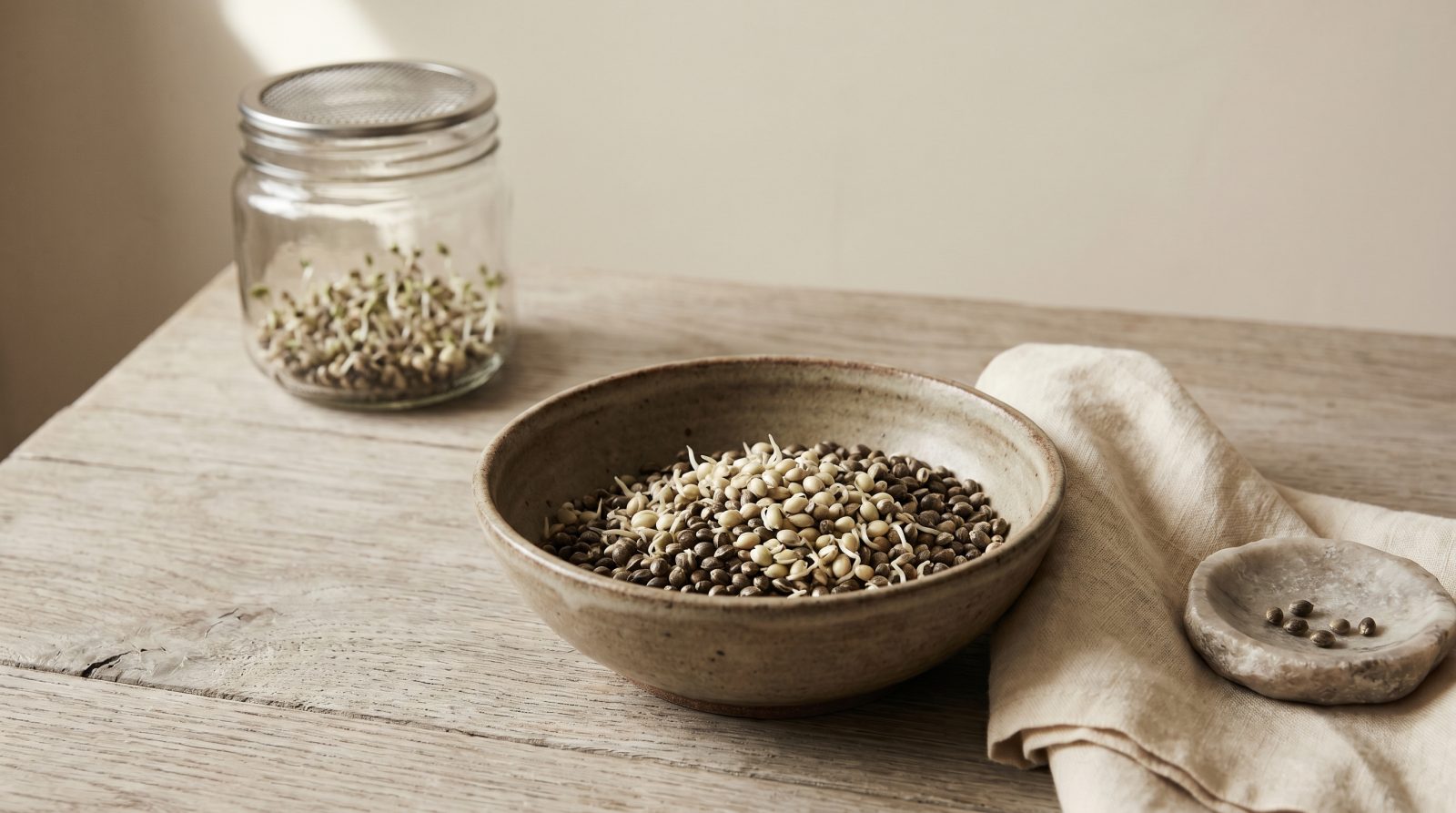
Whole hemp seed, with its shell intact, can be sprouted if the seed is still viable; hulled hemp seed (hemp hearts) cannot. At home it takes a jar, an overnight soak and two rinses a day for three to four days. Health Canada advises against eating any sprouts raw or undercooked, and in Canada viable hemp seed is still a controlled product.
Can hemp seeds be sprouted?
Yes, if they are whole and still alive. A soaked, viable hemp seed splits its shell and pushes out a small white root, usually within a day or two at room temperature.
The catch is the seed. Much of the whole hemp seed sold as food may not be viable, and seed that has been treated so it cannot germinate, or toasted, will only soak up water.
Can you sprout hemp hearts?
No. Hemp hearts are hulled hemp seed, and hulled seed sold as food does not sprout. The heart is essentially the embryo: two seed leaves that hold the seed's oil and protein, with a tiny root bent back alongside them.
Commercial hulling cracks the shell off mechanically, which leaves the embryo bare and breaks a share of the kernels outright. In Canada, a licensed processor that takes in hemp grain for processing must also render it non-viable. Either way, hemp hearts are not expected to sprout: soaked, they go soft and then spoil. Sprouting needs whole seed, shell included, and the shell is where most of the fibre sits (see fibre in hulled versus whole hemp seed).
Is it legal to sprout hemp seed in Canada?
There is no clear yes: viable hemp seed is a controlled product in Canada, and the current law and regulations do not mention sprouts at all. Nothing here is legal advice. A sprout needs a viable seed, and this is how viable seed and sprouts are treated:
- Under the Cannabis Act, a cannabis plant (industrial hemp included) and its parts are cannabis unless they are listed in Schedule 2. Schedule 2 lists a non-viable seed, not a viable one.
- The Industrial Hemp Regulations in force since 2018 (SOR/2018-145) license hemp growing, processing and trade, and require processors to render the grain they process non-viable. They do not mention sprouts; the 1998 regulations they replaced excluded sprouts by name from what they permitted.
- The 2025 amendments (SOR/2025-43, with SOR/2025-44) freed derivatives of non-viable hemp seed from licensing. The government's explanation in the Canada Gazette states that "possession of viable industrial hemp seeds or grain will continue to require an industrial hemp licence."
- Health Canada's own hemp FAQ, last updated in March 2025 and marked for revision, still lists "certain activities with whole industrial hemp plants, including sprouts" (their import, export, sale or provision) among the activities not permitted under the Industrial Hemp Regulations. Its wording dates from the earlier rules, but it is the only official statement on sprouts I found.
Where that leaves germinating hemp seed for food is unsettled. The position at home is unclear too: federal law allows adults up to four cannabis plants per household, Quebec prohibits growing cannabis for personal use and Manitoba prohibits growing non-medical cannabis at home, but no law, regulation or official guidance I found says how the four-plant rule applies to seed germinating in a jar. For a definite answer, ask Health Canada or a lawyer.
The rules are under review: Health Canada consulted on changes in May and June 2026, and a formal proposal is expected in the Canada Gazette, Part I, around spring 2027. I argued for hemp sprouts at the original 1998 consultation; the case for changing the rules now is set out in why Canada's rules on hemp sprouts should change.
How do you sprout hemp seeds?
Soak whole hemp seed for 8 to 12 hours, then rinse and drain it twice a day in a tilted jar until short roots appear, usually after three to four days at room temperature.
What you need
- Whole (unhulled), untoasted hemp seed.
- A clean wide-mouth 1-litre (quart) jar.
- A sprouting lid (mesh or perforated plastic), or cheesecloth and a rubber band.
- A bowl to hold the jar upside down while it drains.
Steps
- Soak (day 1, evening). Rinse about 125 mL (1/2 cup) of seed. Put it in the jar, cover with cool drinking water by about 5 cm (2 inches), and skim off any floating seed, loose shell and debris, which is where contamination is most often found. Soak 8 to 12 hours.
- Drain (day 2, morning). Drain through the lid, rinse with cool water and drain again. Set the jar upside down in the bowl at an angle so water runs out and air gets in. Keep it at about 20 °C, out of direct sun.
- Rinse twice a day (days 2 to 4). Root tips usually show within 24 to 48 hours of the soak. The sprouts are ready when the roots are 6 mm to 1 cm (1/4 to 1/2 inch) long, typically on day 3 or 4.
- Store. Rinse, drain well and refrigerate in a covered container lined with a paper towel. Use within a few days.
What do sprouted hemp seeds taste like?
Mild, fresh and slightly grassy, with a nutty note. The root and seed leaves are tender, but the hard shell splits rather than softens and stays on, so every mouthful has some crunch and fibre.
Health Canada's advice is to cook sprouts thoroughly, so use them where they are heated all the way through: stir-fried over high heat until steaming hot, simmered in soups, stews, dal or grains, baked into bread, savoury muffins or crackers, or toasted in a dry skillet as a crunchy topping. For what heat does to hemp's nutrients, see what cooking does to hemp seed.
Are sprouted hemp seeds more nutritious?
Different rather than clearly better, and the evidence specific to hemp sprouts is thin: a few laboratory studies, none testing health effects in people. One recent study, a 2026 comparison using a single Romanian hemp variety, set whole seed against seed sprouted for five days:
| Per 100 g of dry matter | Whole seed | Sprouted seed |
|---|---|---|
| Protein | 25.1 g | 28.2 g |
| Fat | 31.5 g | 26.4 g |
| Crude fibre | 24.6 g | 30.7 g |
| Phytic acid | 428 mg | 182 mg |
A germinating seed burns some of its oil for energy, so fat falls and protein and fibre make up a larger share of what is left. Phytic acid, which binds minerals such as iron and zinc, fell by more than half, though no study has measured mineral absorption from hemp sprouts. Total phenolic compounds rose almost threefold; protein digestibility in a test-tube assay did not improve. A 2018 Italian study also found more polyphenols and antioxidant activity in sprouts, again only in laboratory assays. Fresh sprouts hold water, so gram for gram they deliver less than dry seed.
Are hemp sprouts safe to eat raw?
Health Canada advises against eating raw or undercooked sprouts of any kind, hemp included. Sprouts can carry Salmonella and E. coli, and the warm, moist conditions that make seeds germinate also let bacteria multiply.
Growing your own does not remove the risk: contamination usually starts on the seed, no treatment can guarantee pathogen-free seed, and bacteria can multiply to high levels during sprouting even in a clean kitchen. To reduce it:
- Start with fresh seed sold as food, from a reputable source, and store it cool and dry.
- Wash your hands with soap and warm water for at least 20 seconds before and after handling seed and sprouts.
- Rinse twice a day so water never stands in the jar, and keep the jar away from other food preparation.
- Refrigerate finished sprouts and cook them thoroughly; high heat kills most harmful bacteria.
- Throw out sprouts that have lost their crispness, look dark, smell musty or show any mould.
Health Canada names children, older adults, pregnant people and people with weakened immune systems as being at greater risk of food poisoning from sprouts; take particular care, and ask a doctor if you are unsure.
Why didn't my hemp seeds sprout?
Most often the seed is not viable: if no root tips appear after two to three days of regular rinsing at room temperature, they are unlikely to, and no change of method will fix that. Otherwise, check for:
- Hulled seed. Hemp hearts will not sprout at all.
- Cold. A cold kitchen slows germination; aim for about 20 °C.
- Too wet or too dry. Standing water can rot seed, and seed that dries out between rinses stalls. Drain fully, but do not skip rinses.
- A sour or musty smell, or mould. Discard the batch, do not reuse that seed, and wash the jar and lid in hot, soapy water.