
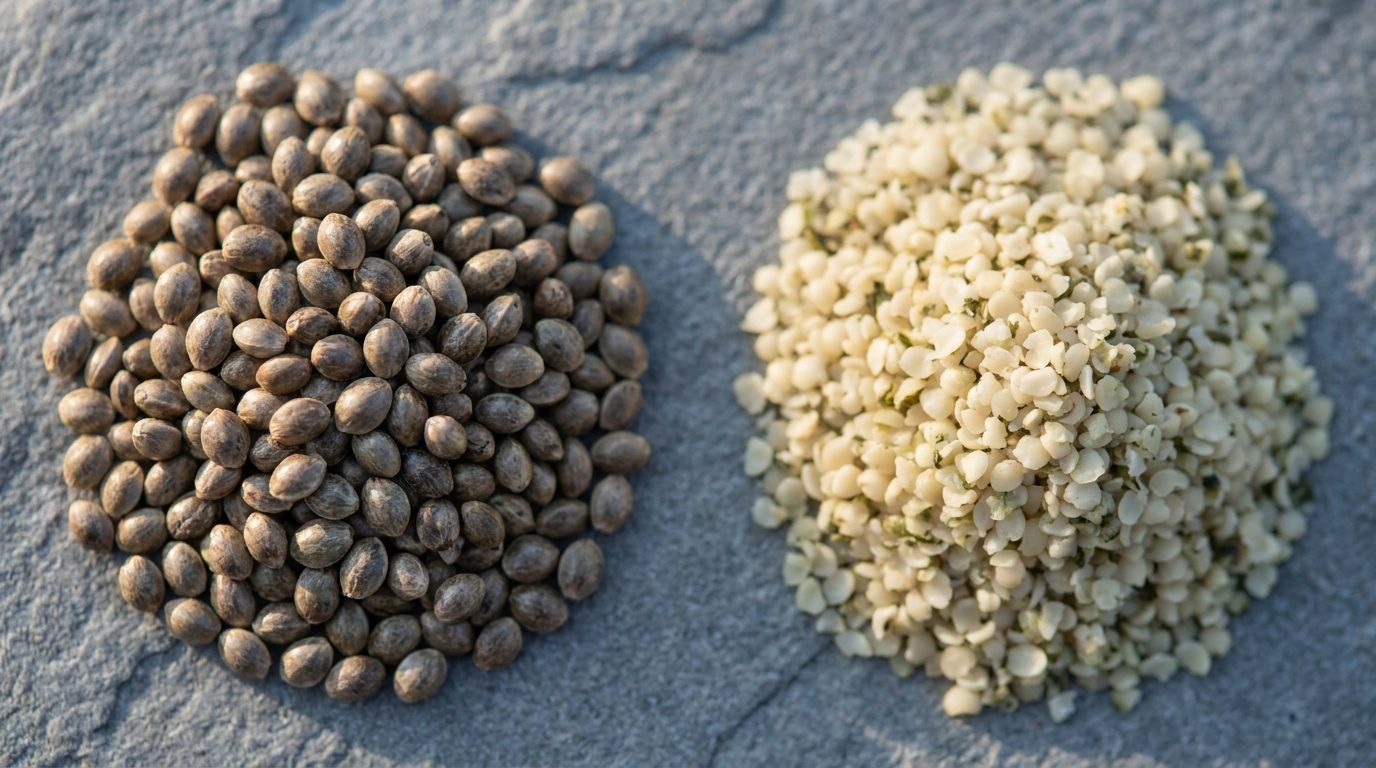
Whether hemp seed counts as a high-fibre food depends almost entirely on one processing decision: whether the hull is still on it. Two products sold under nearly the same name sit at opposite ends of the fibre scale.
Where the fibre in hemp seed actually lives
A whole hemp seed is a soft, oily kernel wrapped in a thin, brittle shell. That shell is structural material — cellulose and related plant polymers — and it is almost pure fibre. The kernel inside is where the fat, the protein and most of the minerals are concentrated, and it carries comparatively little fibre of its own.
Hulled hemp seed, sold as hemp hearts, has had that shell cracked and separated off mechanically. What you buy in the bag is the kernel. That single step removes the large majority of the seed's fibre while leaving the fat and protein essentially intact. It is why two nutrition panels for products both labelled "hemp seed" can disagree so dramatically on one line.
If a listing does not say hulled, shelled or hearts, and the seeds look grey-brown and rounded rather than pale green and soft, you are looking at whole seed and a much higher fibre number.
How much fibre does a serving of hemp hearts give you?
A standard serving of hulled hemp seed is about three tablespoons, roughly 30 grams. That serving contributes a small amount of fibre — real, but minor, in the range of a gram or two. It is a rounding error against a daily target, not a strategy for hitting one.
The same weight of whole hemp seed contributes several times that, because you are eating the hull along with the kernel. Whole seed sits comfortably in the same conversation as other high-fibre seeds; hulled seed does not, and no amount of marketing language changes it.
General guidance for adults lands somewhere around 25 to 35 grams of fibre a day, and most people fall well short. If closing that gap is the goal, hemp hearts are a supporting player at best. Their case rests on fat quality, protein and minerals — not fibre.
Is hemp fibre soluble or insoluble?
The fibre in hemp seed is predominantly insoluble. That matters more than the raw gram count, because the two categories behave completely differently in the gut.
Soluble fibre dissolves and forms a gel. It is the reason soaked chia turns a glass of water into pudding and ground flax makes porridge slippery. It slows gastric emptying, feeds gut bacteria readily, and contributes to the fullness people describe after a chia-heavy breakfast.
Insoluble fibre does none of that. It passes through largely intact, holds water mechanically, adds bulk to stool and tends to speed transit rather than slow it. Practically, this means hemp seed will never thicken a drink, will not set a pudding, and cannot substitute for chia or flax in any recipe where the gel is doing structural work. It also means whole hemp seed acts on regularity through bulk rather than through softening.
Will hemp seed help with regularity?
Whole hemp seed can, in the same way any bulky insoluble fibre can, provided you also drink enough water — insoluble fibre without fluid is a common reason people find that adding fibre made things worse rather than better.
Hulled hemp seed is a much weaker lever, but it is not entirely irrelevant. The fat content of hemp hearts is high, and dietary fat has its own mild effect on transit. People who add several tablespoons a day to an otherwise low-fat diet sometimes notice a change that has nothing to do with fibre at all.
If regularity is specifically what you are after, the honest advice is to build the base from oats, legumes, whole fruit with the skin on, and vegetables, then use hemp hearts for what they are actually good at. Treating them as a fibre supplement sets up a disappointment.
Can whole hemp seed be too rough on the gut?
The hull is genuinely hard and it does not soften meaningfully with soaking the way a grain or a legume does. Whole hemp seed eaten in quantity is closer to eating small, sharp-edged husks than to eating a soft seed, and some people find it uncomfortable or simply unpleasant to chew.
Anyone recovering from gut surgery, managing a flare of an inflammatory bowel condition, or working with a clinician on a low-residue plan should treat whole seed as a food to raise in that conversation rather than an obvious healthy default. Hulled seed sidesteps the issue entirely, which is one of the quieter reasons it dominates the retail shelf.
For everyone else, the practical fix is grinding. Milling whole seed briefly in a spice grinder breaks the hull into fragments small enough to stop registering as grit, and the fibre still counts. Grind small amounts as you need them — the exposed oil does not keep well once the seed is broken open.
Which one belongs in your kitchen
Buy hulled hemp seed if you want a fat-and-protein topping you will actually use every day: it goes on yogurt, salads and toast without changing the texture of anything. Buy whole hemp seed, or keep a small bag alongside the hearts, if you specifically want the fibre and are prepared to grind it or accept the crunch. Store both in the fridge or freezer, buy quantities you will finish within a couple of months, and check the label wording before you assume which one you have — the fibre line on the panel is the fastest way to confirm it. If you want to see how hemp seed's other nutrients stack up, the rest of our hemp seed guides go deeper on fat, protein and minerals.