
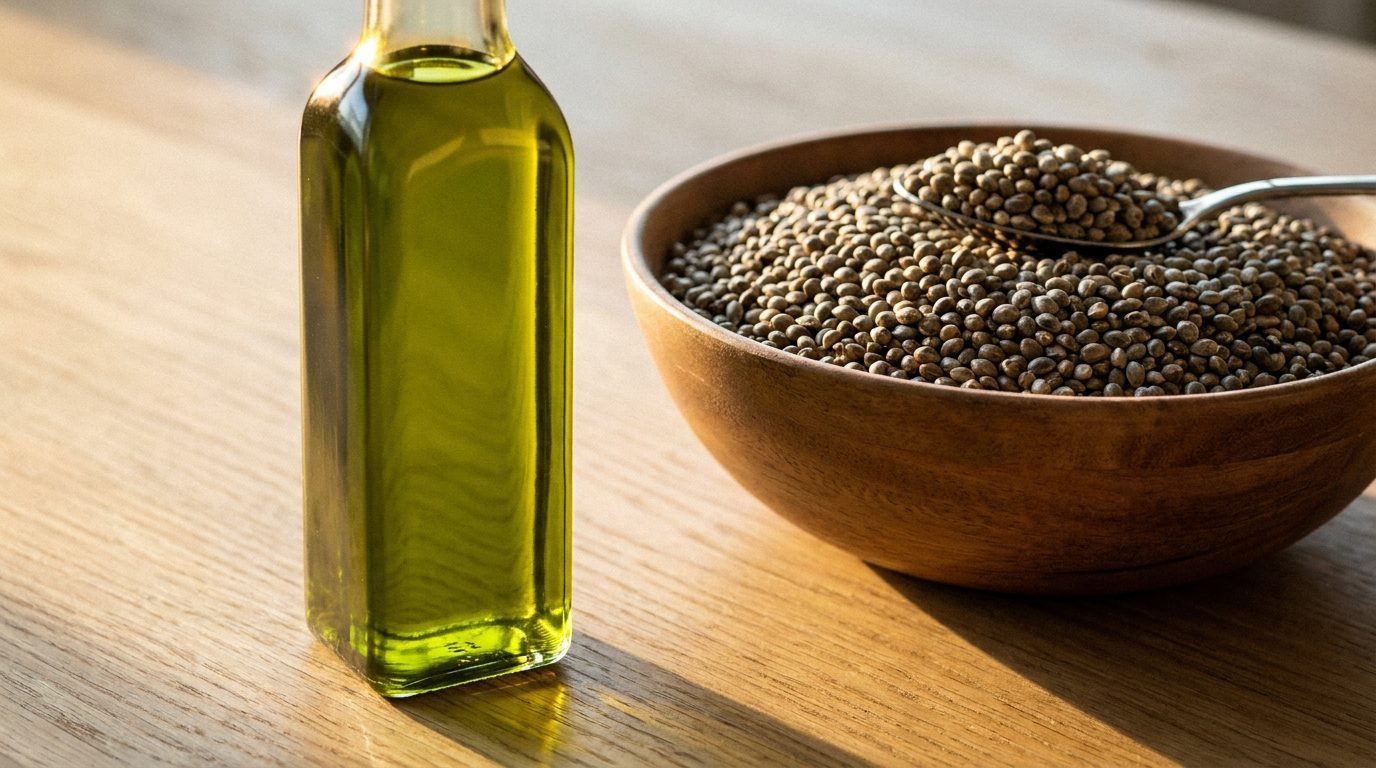
Both products come from the same seed and carry the same fatty acid profile. The difference is concentration, and concentration cuts in two directions at once.
What pressing removes, and what it leaves behind
Hemp seed oil is made by pressing the seed and separating the liquid fat from everything else. What comes out is essentially pure fat. What stays behind in the press cake is the protein, the fibre, the minerals and a residual portion of oil that never releases — that cake is what gets milled into hemp protein powder and hemp flour.
The fatty acid composition of the oil closely mirrors the composition of the fat still inside the seed. Pressing does not selectively concentrate omega-3 over omega-6; it concentrates all the fat equally against everything that is not fat. The much-discussed balance of linoleic acid to alpha-linolenic acid, and the small gamma-linolenic fraction, look broadly the same in both formats.
So the question is never which format has better fat. It is how much fat you end up eating, and what comes with it.
Per spoonful the oil wins — per meal, not always
A tablespoon of oil is almost entirely fat. A tablespoon of hulled hemp seed is roughly half fat by weight, with protein, fibre and water making up the rest. On a spoon-for-spoon basis the oil delivers something like three times the omega-3.
| One tablespoon hemp seed oil | One tablespoon hemp hearts | |
|---|---|---|
| Total fat | About 14 g | About 5 g |
| Omega-3 (ALA) | Roughly 2.5 g | Roughly 0.8 g |
| Protein | None | About 3 g |
| Minerals | Negligible | Meaningful magnesium, zinc, phosphorus |
But spoons are not how people eat. Almost nobody takes three tablespoons of oil in a day, while three tablespoons of hemp hearts on yogurt is an ordinary breakfast. In practice, the seed is the format most people consume in enough volume to matter, and a habit you keep beats a concentrate you use twice a week.
What you give up by taking the oil alone
Hemp seed's nutritional case is not solely about fat. The seed supplies a complete protein, a substantial magnesium contribution, useful zinc and phosphorus, and — if the hull is still on — fibre. The oil supplies none of that. It is a fat, full stop, in the same category as olive oil or walnut oil.
This becomes a real consideration if you are treating hemp as a protein contributor or a mineral source. Swapping seeds for oil in that role quietly removes most of what you were counting on. It also removes satiety: a spoon of oil on a salad does very little to make a meal filling, while the same energy as seeds does noticeably more.
Which one goes off first
Both are vulnerable, and both go off in the same way — oxygen attacking the double bonds that make polyunsaturated fat useful in the first place. The differences are practical rather than chemical.
Oil in a bottle has a large surface area exposed to whatever air is in the headspace, and that headspace grows every time you pour. It is also frequently sold in clear glass and stored on a counter, which is close to the worst case. Good hemp oil comes in dark glass or opaque bottles and goes straight into the fridge after opening.
Whole seed is the most stable format of the three, because the hull is a physical barrier. Hulled seed sits in between: cracked open, but with the fat still held in cell structures rather than pooled in a bottle. Whichever you buy, cold storage and small quantities do more for freshness than any label claim.
When the oil is genuinely the better tool
There are situations where oil is the right answer and seeds are not.
- Dressings and finishing oils. Hemp oil's grassy, faintly nutty character works beautifully whisked into vinaigrette or drizzled over soup at the table, where whole seeds would just sink.
- Blended drinks where texture matters. A spoon of oil disappears into a smoothie without the faint graininess seeds can leave.
- Getting fat into small appetites. When calorie density is the goal and volume is the obstacle, oil does what seeds cannot.
- Recipes that already need oil. Substituting hemp oil for a neutral oil in a no-heat application upgrades the fat profile at no extra effort.
Neither format belongs in a hot pan. Both carry the same fragile polyunsaturated fats, and high heat degrades them regardless of which container they arrived in.
Choosing between them
If you buy only one, buy hulled seed — it delivers fat, protein and minerals together, keeps better than oil, and is easy to use daily without thinking about it. Add oil as a second purchase when you make dressings often enough to finish a bottle within a few weeks of opening. Keep the oil in dark glass in the fridge, keep the seeds cold too, and treat both as ingredients you add after the heat rather than during it. Our other hemp seed guides go further into how the fat profile behaves once it leaves the bottle.