
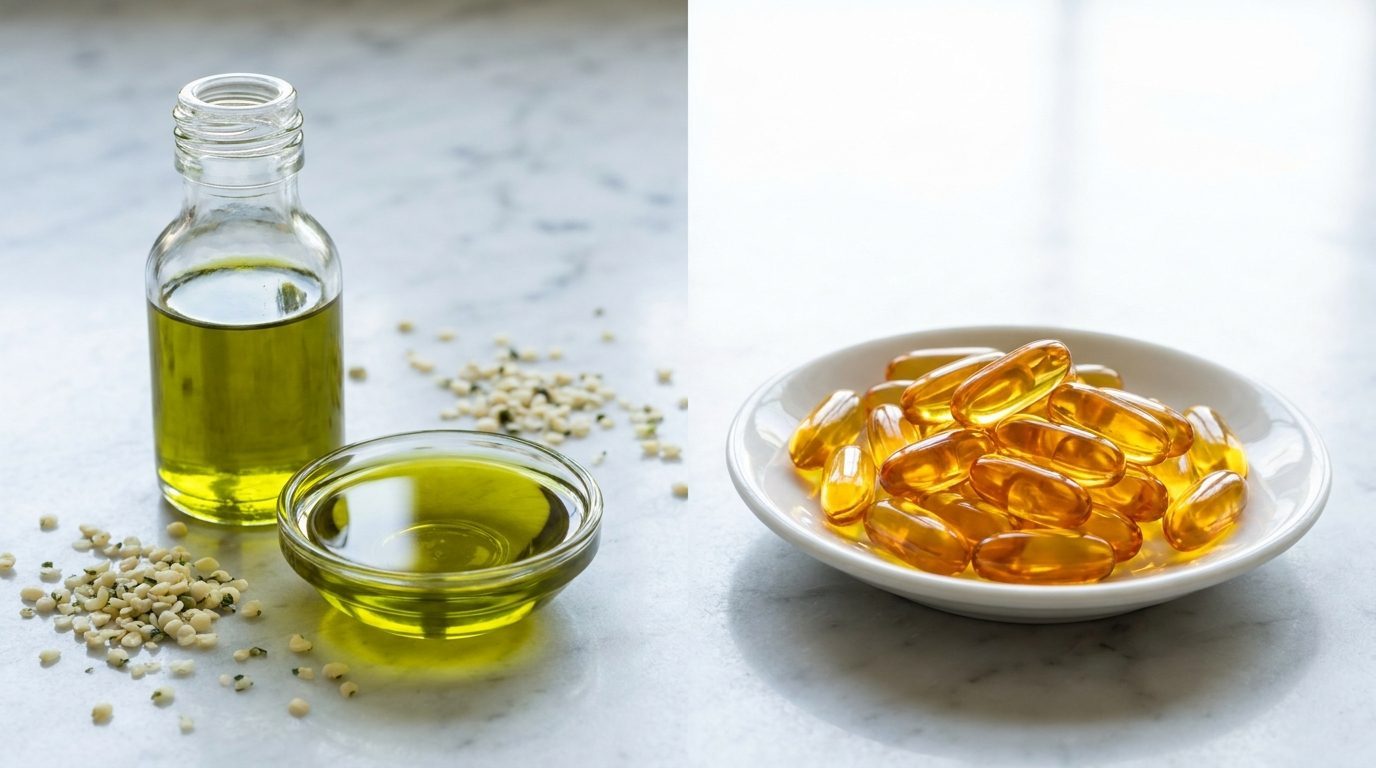
Hemp seed and fish oil both get filed under "omega-3," but they are not the same molecule doing the same job. Hemp gives you ALA, a precursor your body must convert; fish oil hands you the finished EPA and DHA directly. The honest question is how much of that conversion actually happens, and the answer decides whether hemp is enough for you or whether you still need something more.
What kind of omega-3 is actually in hemp seed?
Hemp seed and hemp seed oil contain omega-3 in the form of alpha-linolenic acid, or ALA. ALA is the "parent" omega-3: an 18-carbon fatty acid that the human body cannot make on its own, which is why it counts as essential. Flax, chia, walnuts, and canola supply the same ALA. No plant seed contains meaningful EPA or DHA.
Fish oil is different in kind, not just in source. It delivers the two long-chain omega-3s your tissues use directly: eicosapentaenoic acid (EPA) and docosahexaenoic acid (DHA). These are the molecules built into cell membranes in your brain, retina, and heart, and the ones research on omega-3 benefits is overwhelmingly built around.
So when a hemp label advertises omega-3, it is telling the truth, but the omega-3 it means is ALA. Whether that ALA does you the same good as the EPA and DHA in fish depends entirely on a conversion step that happens inside your body, and that step is the whole story.
Does ALA actually convert to EPA and DHA?
Yes, but inefficiently, and the gap between the two conversions is the part that matters. Your body uses a chain of enzymes (the same desaturase and elongase enzymes that also process omega-6 fats) to lengthen ALA into EPA and then, in further steps, into DHA. Both steps are bottlenecked, and the second one far more than the first.
Stated as honest general ranges rather than a single magic number:
- ALA to EPA: a modest single-digit to low-double-digit percentage of the ALA you eat. Some gets through.
- ALA to DHA: very low, often well under a few percent, and in many people effectively negligible.
The conversion is also not a fixed dial. Several things suppress it further. A diet heavy in omega-6 linoleic acid competes for the very same enzymes, so a typical Western fat intake quietly throttles your ALA conversion. Conversion efficiency tends to be lower in men than in pre-menopausal women (estrogen appears to favour DHA synthesis), and it generally declines with low intakes of the nutrient cofactors those enzymes depend on. The practical upshot: you cannot assume that eating more ALA simply scales up your DHA. The DHA ceiling stays stubbornly low almost regardless of how much hemp you eat.
Hemp seed omega-3 vs fish oil: a side-by-side
The comparison is less "which is better" and more "which problem are you solving." Here is the honest layout.
| Factor | Hemp seed / hemp oil | Fish oil |
|---|---|---|
| Omega-3 form | ALA (precursor) | EPA and DHA (ready to use) |
| Reaches tissues directly | Only after limited conversion | Yes |
| Reliable DHA delivery | No | Yes |
| Omega-6 to omega-3 balance | Naturally favourable (roughly 3:1 to 4:1) | Negligible omega-6 |
| Also a whole food | Yes: protein, fibre, minerals, GLA | No, a fat supplement |
| Plant-based / vegan | Yes | No |
| Sustainability concerns | Low (annual field crop) | Fishery pressure varies |
| Oxidation / fishy aftertaste | Mild nutty oxidation if stored warm | Common if rancid |
Read down that table and the verdict writes itself: hemp wins on food value, balance, and sustainability, while fish oil wins decisively on the one thing hemp physically cannot do, which is put EPA and especially DHA into your bloodstream without relying on a conversion you do not control.
What hemp's omega-3 still does well
It would be a mistake to read "low conversion" as "useless." Hemp seed brings real advantages that have nothing to do with chasing DHA:
- A genuinely good fat ratio. Hemp's omega-6 to omega-3 ratio sits in a range nutritionists consider favourable, the opposite of the lopsided ratio most people get from refined seed oils and processed food. Lowering background omega-6 is itself one of the levers that helps whatever ALA conversion you do have.
- ALA has roles of its own. Not every benefit of ALA depends on it becoming EPA or DHA. ALA is used directly as a fuel and as a structural fat, and a higher dietary ALA intake is associated with cardiovascular benefit in its own right.
- GLA, the omega-6 most foods lack. Hemp uniquely supplies gamma-linolenic acid, an anti-inflammatory omega-6 not found in most everyday foods.
- It is a whole food, not a pill. A spoonful of hemp hearts is also complete protein, fibre, magnesium, zinc, and iron. Fish oil is a single isolated fat.
In other words, hemp earns its place in the diet on the strength of the whole seed. The omega-3 is one reason among several, not the only reason, and that framing keeps expectations honest.
When is hemp enough, and when do you still need algae DHA?
Here is the practical verdict the conversion math points to.
Hemp alone is reasonable if: you also eat oily fish regularly (the fish, not the seed, is covering your EPA and DHA), or you are a generally healthy adult using hemp as part of a balanced diet and not relying on it as your sole omega-3 strategy. In these cases hemp improves your fat profile and you are getting long-chain omega-3 from elsewhere.
You likely need a direct DHA source if: you are vegan or vegetarian, pregnant or breastfeeding (DHA demand is high and the stakes for fetal and infant brain development are real), older, or simply someone who eats little to no fish. For these groups, expecting hemp's ALA to backfill your DHA is the exact assumption the conversion data warns against.
For plant-based eaters, the clean answer is algae oil. Microalgae are where the fish get their DHA in the first place, so an algal supplement delivers preformed DHA (and often EPA) directly, with no conversion step and no fish. The sensible plant-based stack is therefore both: hemp seed for the favourable fat ratio, whole-food nutrition, and baseline ALA, plus a modest algae-DHA supplement to guarantee the long-chain omega-3 that hemp cannot reliably make for you. That combination gives a vegan diet what an omnivore gets from "salad oil plus salmon."
The honest bottom line
Treat hemp seed as an excellent omega-3-balancing food, not as a fish-oil replacement. It corrects the omega-6 overload most diets carry, delivers ALA and GLA, and arrives wrapped in protein and minerals, and on those terms it is hard to beat. What it cannot do is dependably top up your EPA and DHA, because the ALA-to-DHA conversion is too leaky to trust for that job. If you eat fish, hemp rounds out the picture nicely. If you do not, pair hemp with algae-derived DHA and stop asking one humble seed to perform biochemistry it was never going to win. To see how hemp's full fat and nutrient profile fits into everyday eating, browse the rest of our articles.